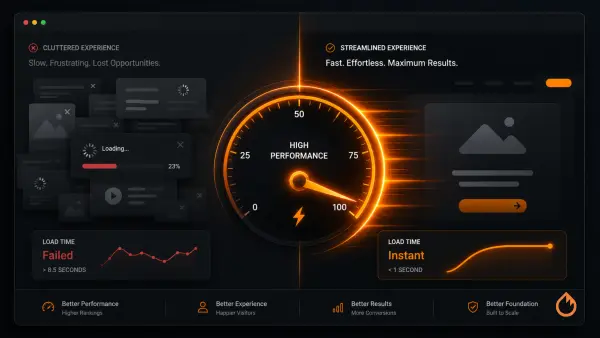
E-commerce businesses are currently losing significant visibility because they rely on traditional keyword strategies. Generative engines now prioritize intent-based answers over simple keyword matches. This article explains why your current strategy likely causes a 30% traffic leakage and how e-commerce performance engineering can help you reclaim that ground.
The Shift from Keywords to Intent
Traditional SEO tactics focus on high-volume keywords. This approach is becoming less effective as search evolves. Generative AI engines prioritize solving user problems through direct, accurate answers. They evaluate your site based on how quickly it answers a query and how well the information is structured.
If your site takes longer than two seconds to load, AI engines will deprioritize your content. This happens even if your keywords are perfect. You are optimizing for a search environment that no longer exists in its previous form. By focusing on technical SEO for AI search, you align your site with how modern engines actually ingest data.
Identifying the 30% Traffic Leak
The lost 30% of traffic consists of users who would have converted but were served a competitor's site by an AI. This occurs because the competitor site was technically faster or provided a cleaner data structure.
| Traffic Source | Traditional SEO Performance | Generative Engine Performance |
|---|---|---|
| High-Volume Keywords | High | Low |
| Intent-Based Queries | Low | High |
| Technical Reliability | Neutral | High |
This leakage happens when your site architecture fails to communicate clearly with AI crawlers. You are reducing e-commerce traffic leakage when your content is built to be parsed as an authoritative answer.
The Engineering Solution: Prioritizing E-commerce Performance
You must shift your focus from simply writing content to building an architecture that facilitates knowledge retrieval. This requires two specific technical shifts.
First, you must treat latency as a primary ranking factor. Every millisecond of delay increases the probability that a generative engine will discard your page during its initial crawl. You should transition to high-performance stacks like the one powering Fenix Media to ensure instant delivery of your content.
Second, you must prioritize structured data. AI models do not read websites like humans read a newspaper. They ingest data packets. By implementing precise Schema markup and clean semantic HTML, you provide a roadmap for AI crawlers to index your expertise correctly. This is the bridge between human content and AI understanding.
Actionable Framework
You can start reclaiming your lost traffic by executing this three-step framework today.
- Audit Current Mobile Core Web Vitals: Your mobile performance is now your search performance. Use Google’s Core Web Vitals to identify rendering delays and correct them immediately.
- Map Content Against Intent: Stop targeting high-volume keywords alone. Instead, identify the specific questions your clients ask during the buying process and create long-form content that answers those questions comprehensively.
- Implement Answer-First Structures: Refactor your existing top-performing pages to include an executive summary at the top. This makes your content eligible for inclusion in AI Overviews, which is the primary goal of modern Generative Engine Optimization (GEO).
Reclaim Your Growth
The digital landscape has changed, but the opportunity for high-performance brands is greater than ever. You must ensure your technical infrastructure meets modern standards to remain competitive in this new search environment. At Fenix Media, we specialize in bridging the gap between technical infrastructure and measurable marketing outcomes. If you are ready to stop losing traffic and start engineering your growth, let us build your performance system today. Reach out to Fenix Media for a technical audit of your current stack.